
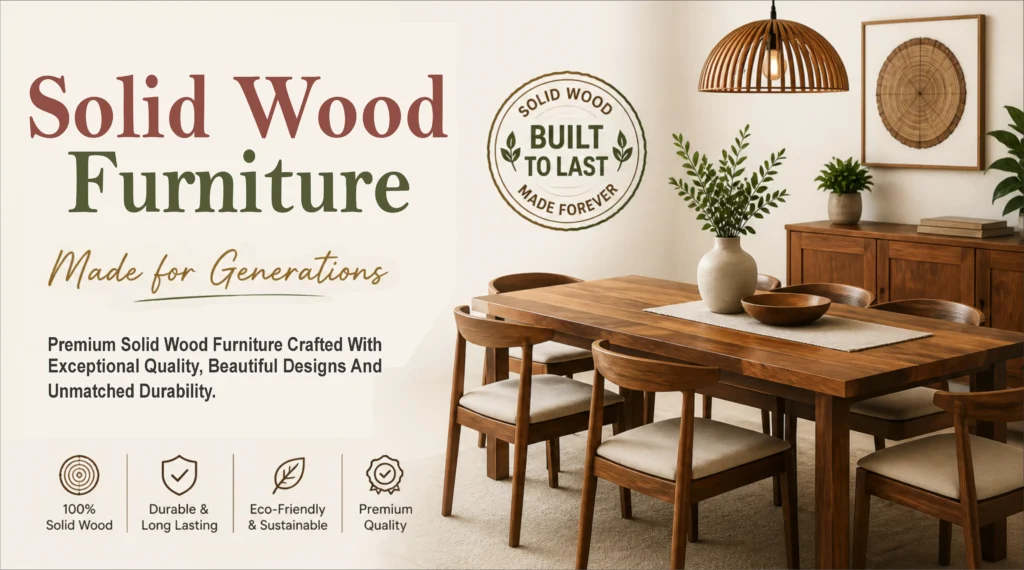
Walk into any furniture market in Pakistan, from Daraz listings to local showrooms, and you will see one phrase used everywhere: solid wood. The problem? Most of it is not. MDF panels wrapped in wood-grain laminate, particleboard cabinets with a thin veneer on top, and engineered boards finished to look like real timber are all routinely sold as ‘wooden furniture’ in Pakistan.
For buyers investing in quality pieces that last for years, this matters enormously. Real solid acacia wood furniture looks better with age, survives Pakistan’s extreme summer humidity, can be repaired and refinished, and holds its structural integrity for decades. Fake wood, MDF, particle board, laminate, warps, swells, and disintegrates within 12 to 18 months in typical Pakistani home conditions.
This guide gives you seven practical, hands-on tests you can perform in any showroom, at a Daraz COD doorstep, or in a local karkhana, no tools, no expertise required. By the end, you will never be misled again.
| To identify genuine solid wood furniture: (1) check that the grain pattern is irregular and continues around edges, (2) confirm the piece is noticeably heavy, (3) smell for a natural earthy scent rather than chemicals, (4) look for dovetail or mortise-and-tenon joinery on drawers, (5) examine the underside for unfinished natural wood, (6) run your fingernail across the surface to feel real pores and texture, and (7) verify that the seller can name the exact wood species used. |
What Is Genuine Solid Wood? (And What It Is Not)
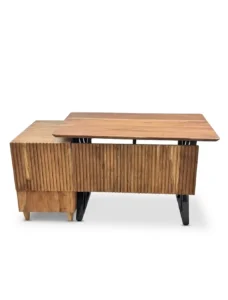 Before applying any test, it helps to understand exactly what you are looking for. Solid wood means that every structural component, the frame, legs, tabletop, shelf boards, and panels — is cut from thick, unprocessed natural timber. No adhesives binding wood shavings together, no synthetic core, no thin layer of real wood glued over a fake base.
The four materials most often sold as ‘wood’ in Pakistan
- Solid Wood:
Cut directly from natural logs. Dense, heavy, unique grain patterns. Expands and contracts slightly with humidity — this is normal and actually a sign of real wood. Can be sanded, refinished, and repaired for generations. In Pakistan, common solid wood species include acacia (kikar), sheesham (rosewood), deodar, kail, and mango wood.
- MDF (Medium Density Fibreboard):
Made from wood fibres and resin compressed into flat boards. Smooth, uniform surface with no grain. Cannot be sanded or refinished. Absorbs moisture rapidly in Pakistan’s summer humidity and warps or swells permanently. Often has a wood-print laminate surface.
- Particle Board / Chipboard:
Made from wood shavings, sawdust, and glue compressed under heat. Even weaker than MDF. Very light, very cheap, used in most Daraz ‘assembly required’ furniture. Screws do not hold well in particleboard — it crumbles around fixings with regular use.
- Veneer:
A thin slice of genuine wood (often 0.5 to 3mm thick) glued over an MDF or particleboard base. Looks like real wood from the surface but is fragile, cannot be deeply refinished, and shows its base material at the edges and back.
| Pakistan Context — Why This Matters More Here Pakistan’s summers regularly see temperatures above 42°C with high humidity in cities like Lahore, Multan, and Karachi. MDF and particle board swell, de-laminate, and warp in these conditions within a single summer season. Solid acacia wood naturally adjusts to humidity changes without structural damage — making it the only sensible long-term investment for Pakistani homes. |
7 Expert Tests to Identify Real Solid Wood Furniture
Test 1 — The Grain Pattern Test (Most Reliable)
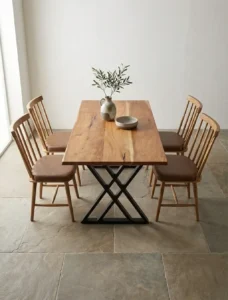
The grain pattern is the single most reliable indicator of genuine solid wood. Every tree has a completely unique growth pattern — no two solid wood pieces will ever look identical.
What to look for — Real solid wood:
- The grain pattern is irregular, varies across the surface, and has knots, colour shifts, and natural inconsistencies.
- Look at the top surface, then check the side panel. In genuine solid wood, the grain continues naturally around the edge or joins with a matching grain on the adjacent face.
- If there is a knot on one surface, the corresponding mark or disruption should appear on the adjoining surface too.
Red flags — Fake wood:
- The grain pattern repeats perfectly — like a printed tile pattern. This is a laminate or veneer print.
- The grain stops abruptly at the edge rather than flowing around the corner.
- The surface looks too perfect, too uniform — real trees do not grow that evenly.
Test 2 — The Weight Test
Solid wood is dense. A genuine solid acacia dining table or wardrobe should feel noticeably heavy — it should take effort and preferably two people to move. This is one of the quickest tests you can perform.
- A solid acacia wood shoe rack (small, 91 × 38 × 62 cm) should feel dense and stable when you try to lift one side.
- If a large cabinet or table feels surprisingly light — light enough that one person can easily carry it — it is almost certainly MDF or particle board.
- Important caveat: some MDF boards are heavier than expected. Always combine the weight test with at least two other tests.
Test 3 — The Smell Test (Unique to This Guide)
This test is often left out of competitor guides but is surprisingly effective — especially when buying furniture in person or receiving a COD delivery.
How to do it:
Lean close to an unfinished area — the underside, inside a drawer, or the back of the piece — and inhale. Real solid wood, especially species like acacia, sheesham, and mango wood, has a distinct natural earthy or woody scent. Each wood species smells slightly different.
- Real solid acacia:
A subtle, warm, earthy smell — similar to fresh timber or sawdust from a woodshop.
- MDF or particle board:
A chemical smell — sharp, glue-like, or faintly plastic. This comes from the formaldehyde-based resins used to bind the compressed fibres.
- Laminate or veneer:
A faint plastic or lacquer smell, especially on new pieces.
Test 4 — The Joinery Test (Check the Drawers and Joints)
How the pieces of furniture are joined together reveals a great deal about whether it is genuine solid wood. Traditional solid wood craftsmanship uses specific joinery techniques that are impossible to fake with particle board or MDF.
What to look for on drawers:
- Dovetail joints:
Interlocking wedge-shaped ‘teeth’ where the drawer side meets the drawer front. You can see and feel these interlocking pieces. This is the gold standard of solid wood joinery — it cannot be done with particle board.
- Mortise and tenon:
A tab on one piece fits into a slot on the other — strong, traditional, and a sign of genuine craftsmanship.
Red flags:
- Drawers held together with staples, visible metal L-brackets, or plastic corner caps.
- Joints that wiggle or feel loose — solid wood joinery should feel completely rigid.
- Cam locks or wooden dowels only — these are typical of flat-pack, engineered wood furniture.
Test 5 — The Underside and Back Test
Furniture manufacturers spend their budget where buyers look. The underside, back panels, and inside of drawers are where they cut corners — and where the truth about a piece’s construction is most visible.
- Flip the piece over or crouch down and look at the underside. Genuine solid wood furniture will often show unfinished or lightly finished natural wood — the grain is visible, the surface feels raw.
- Look at the back panel of a cabinet or wardrobe. Solid wood backs are thick and solid. Fake wood backs are thin, laminated on both sides, and often a noticeably different material.
- Open a drawer and look inside. Real wood drawers have natural grain on the inner walls. MDF drawers are perfectly smooth, or show compressed fibre if you look at a cut edge.
| Pakistan-Specific Tip — COD Delivery Check If you are receiving furniture via cash on delivery, ask the delivery person to wait while you perform this check before paying. Open a drawer, look at the back panel, and check the underside. Reputable solid wood sellers, including Solid Wood at solidwood.pk — will always encourage this inspection. Any seller who refuses or pressures you to pay before checking is a red flag. |
Test 6 — The Surface Texture Test
Real wood is a natural, porous material. Run your fingertip — or better, your fingernail — lightly across an unfinished area of the piece.
- Solid wood has a slight resistance or catch — you can feel the open pores of the wood fibres. Even when sealed, there is a subtle texture to the surface.
- Laminate feels smooth, uniform, and slightly hard — like running your finger across plastic, because that is essentially what it is.
- MDF surfaces feel perfectly flat and slightly chalky when unfinished.
On an acacia wood piece, you will also notice the naturally multi-tonal colour — patches of darker and lighter brown that cannot be replicated by a printed laminate film.
Test 7 — Ask the Seller (The Transparency Test)
This is perhaps the simplest and most powerful test of all — and consistently overlooked in competitor guides.
Ask the seller directly: What type of wood is this made from? Where is it sourced? How is it finished?
- A genuine solid wood seller will immediately and confidently answer: ‘This is solid acacia wood, naturally seasoned, with a hand-rubbed matte finish’ — or words to that effect. They will know the species, the treatment, and the construction method.
- A seller who sells fake wood will give vague answers: ‘It’s good quality wood,’ ‘It’s natural wood,’ or ‘It’s high-quality material’ — all of which avoid naming the actual species.
- If a seller cannot tell you the exact wood species and where it was sourced, walk away.
| How do I know if furniture is real wood? Check these 7 things: irregular grain that continues around edges, heavy weight, natural earthy smell, dovetail or mortise-and-tenon drawer joints, unfinished wood on the underside, a porous tactile surface, and a seller who can name the exact wood species. MDF and fake wood furniture fails at least 3 of these 7 tests. |
Quick Reference: Real Solid Wood vs Fake — Side by Side
| Sign | Real Solid Wood | MDF / Veneer / Fake |
| Grain pattern | Irregular, unique, flows around edges | Repeating, perfectly uniform, stops at edges |
| Weight | Heavy — takes 2 people to move | Surprisingly light for its size |
| Smell | Earthy, natural woody scent | Chemical, glue, or plastic smell |
| Edges/corners | Grain continues naturally around edges | Grain abruptly stops or seam visible |
| Joints (drawers) | Dovetail or mortise-and-tenon | Staples, metal brackets, plastic caps |
| Underside/back | Unfinished natural wood visible | Fully laminated or particleboard visible |
| Texture | Tactile, porous — fingernail catches slightly | Smooth, plastic-like, uniform feel |
| Price | Higher — reflects real material cost | Suspiciously cheap for the size |
| Humidity response | Slight seasonal expansion/contraction (normal) | Swells, warps, de-laminates in Pakistan heat |
Acacia Wood Specifically — Pakistan’s Best Choice and How to Verify It
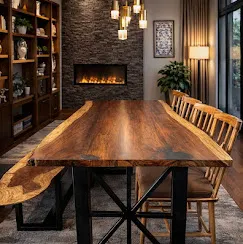
Among all wood species available in Pakistan, solid acacia (locally grown kikar) is particularly well-suited for home furniture. It is one of the densest and most moisture-resistant hardwoods available at a reasonable price point — which is why Solid Wood uses it exclusively.
How to verify genuine acacia wood
- Colour:
Natural acacia ranges from warm caramel to deep dark brown, sometimes with reddish-gold streaks. The colour is never uniform — it shifts across the surface and from piece to piece.
- Grain:
Acacia has an interlocked or wavy grain pattern — it will never look like straight even lines. You will see natural arcs, swirls, and occasional knots.
- Weight:
Acacia is a dense hardwood. A small shoe rack (91 × 38 × 62 cm) should feel heavier than expected for its size.
- Smell:
Acacia has a mild, clean, slightly sweet woody scent — not strong like sheesham, but clearly natural and not chemical.
- Surface:
Even with a matte finish, acacia has visible open pores and slight texture — it never feels as smooth as laminate or MDF.
Why acacia outperforms MDF in Pakistan’s climate
- Acacia wood naturally expands and contracts slightly with humidity changes — this is normal and causes no structural damage.
- MDF absorbs moisture permanently. In Multan or Lahore summers, MDF furniture can swell by 2 to 5 mm and never returns to its original shape.
- Acacia can be sanded, re-oiled, or refinished if scratched. MDF cannot be repaired — once the surface is damaged, it is damaged permanently.
- Acacia furniture made today, properly maintained, will still be solid and structurally sound for your children’s homes. MDF furniture typically has a 2 to 5 year useful lifespan under Pakistani conditions.
Your 5-Minute Solid Wood Verification Checklist
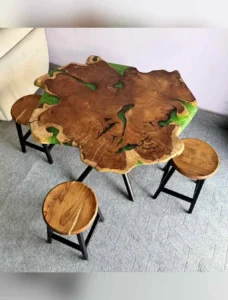
Use this checklist in any showroom, at a COD delivery, or when inspecting local karkhana furniture. Print it or save it on your phone.
- Look at the top, run your eye to the side — does the grain continue naturally? Is it irregular and unique? Grain check:
- Try to lift one end or corner. Does it feel genuinely heavy and dense? Weight check:
- Lean close to an unfinished area. Natural earthy smell = real wood. Chemical smell = fake. Smell check:
- Open a drawer and look at the corner where the side meets the front. Dovetail or mortise-and-tenon = real. Staples or brackets = fake. Drawer joint check:
- Look at the bottom. Unfinished grain = real wood. Laminated on all sides = engineered. Underside check:
- Run your fingernail lightly across a surface. Slight pore resistance = real. Smooth and plastic-like = fake. Texture check:
- Ask: ‘What species of wood is this?’ Clear confident answer = trustworthy. Vague answer = red flag. Seller check:
| Solid Wood Guarantee — solidwood.pk Every piece at Solid Wood is made from 100% naturally seasoned solid acacia wood — never MDF, particle board, or engineered board. Our craftsmen are happy to answer questions about the wood species, finish, and joinery used in any piece. Visit our collection at solidwood.pk or contact us on WhatsApp for a personalized consultation. Cash on delivery available nationwide across Pakistan. |
Explore Solid Wood’s Genuine Acacia Collection
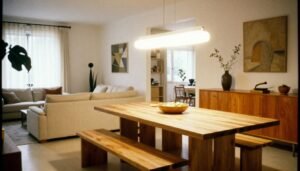
Now that you know how to identify real solid wood, explore our verified solid acacia pieces:
- Solid Acacia Wood Shoe Rack — 3-tier freestanding entryway organizer
- Solid Acacia Wood Standing Mirror — live-edge, full-length
- Solid Acacia Dining Tables — custom and standard sizes
- Custom bespoke furniture — any size, any design, same solid acacia guarantee
Browse all collections at solidwood.pk — nationwide delivery, cash on delivery available.
FAQs
| Q: How can I tell if furniture is solid wood or MDF? A: Check these four things: (1) The grain pattern should be irregular and continue naturally around the edges — MDF has no grain. (2) The piece should be noticeably heavy. (3) Smell an unfinished area — real wood smells earthy and natural; MDF smells chemical. (4) Look at the underside — solid wood shows unfinished natural grain; MDF is smooth and laminated on all sides. |
| Q: Is acacia wood real solid wood? A: Yes. Solid acacia wood (also known as kikar in Pakistan) is 100% natural hardwood cut from acacia trees. It is one of the densest, most moisture-resistant, and most durable hardwoods available in Pakistan — significantly superior to MDF, particle board, or veneered furniture for longevity and quality. |
| Q: How do I identify genuine solid wood furniture in Pakistan? A: In Pakistan, the most reliable tests are: check the grain pattern for natural irregularity, feel the weight (solid wood is genuinely heavy), smell for a natural woody scent rather than chemical glue, check drawer joints for dovetail construction, and ask the seller to name the exact wood species. On Daraz or COD deliveries, inspect the underside and back panel before paying. |
| Q: What is the difference between solid wood and MDF furniture? A: Solid wood is cut from natural logs and has unique grain patterns, real pores, and natural weight. It can be repaired, refinished, and lasts for decades. MDF (Medium Density Fibreboard) is made from compressed wood fibres and resin — it has no grain, absorbs moisture permanently, cannot be repaired when damaged, and typically lasts 2 to 5 years under Pakistani climate conditions. |
| Q: Does genuine solid wood furniture expand or warp in Pakistan’s heat? A: Real solid wood does expand and contract slightly with seasonal humidity changes — this is completely normal and actually confirms authenticity. However, solid acacia wood does not warp, de-laminate, or swell permanently. In contrast, MDF and particle board absorb moisture permanently in Pakistan’s summer heat and permanently deform — often within a single hot season. |
| Q: Can you identify real wood furniture by smell? A: Yes. Genuine solid wood has a natural, earthy, slightly woody scent — especially on unfinished areas like the underside or inside drawers. Acacia wood has a mild, clean natural smell. MDF and particle board emit a chemical smell from the formaldehyde-based resins used in their manufacture. This smell test is especially useful when inspecting furniture in person. |
| Q: What is the best solid wood for furniture in Pakistan? A: In Pakistan, the best solid wood options for furniture are solid acacia (kikar), sheesham (Indian rosewood), deodar (Himalayan cedar), and mango wood. Solid acacia is particularly recommended for its density, moisture resistance, and relatively accessible price point compared to sheesham. It is the wood used in all pieces at Solid Wood (solidwood.pk). |
| Q: How do I verify solid wood furniture on a COD delivery? A: Before paying on cash on delivery: (1) Open a drawer and check the joint — dovetail means real wood. (2) Look at the underside — unfinished grain means real wood. (3) Smell an unfinished area. (4) Check the back panel for thickness and material. (5) Feel the surface texture for natural pores. Any genuine solid wood seller will encourage this inspection before payment. |
Final Thoughts — Invest in Wood That Lasts
Pakistan’s furniture market is filled with pieces marketed as solid wood that are actually MDF, particle board, or veneered engineered board. These materials have their place, but they should never be sold as solid wood — and they should never be what you pay solid wood prices for.
The seven tests in this guide — grain pattern, weight, smell, joinery, underside, texture, and seller transparency — give you everything you need to verify furniture quality in under five minutes, anywhere in Pakistan. Use them every time.
At Solid Wood, we make only solid acacia wood pieces and are always happy to demonstrate any of these tests on our furniture. Every piece comes with complete transparency about the wood species, finish, and construction — because real solid wood speaks for itself.
Shop verified solid acacia wood furniture at solidwood.pk — nationwide delivery with cash on delivery across Pakistan.